An Ancient, Awarded, Self-Reflexive Developer Portfolio
A nostalgic case study about a destructible web surface, hand-crafted, awarded, referenced, open-sourced, and carried forward by the developer community — built and preserved against time.
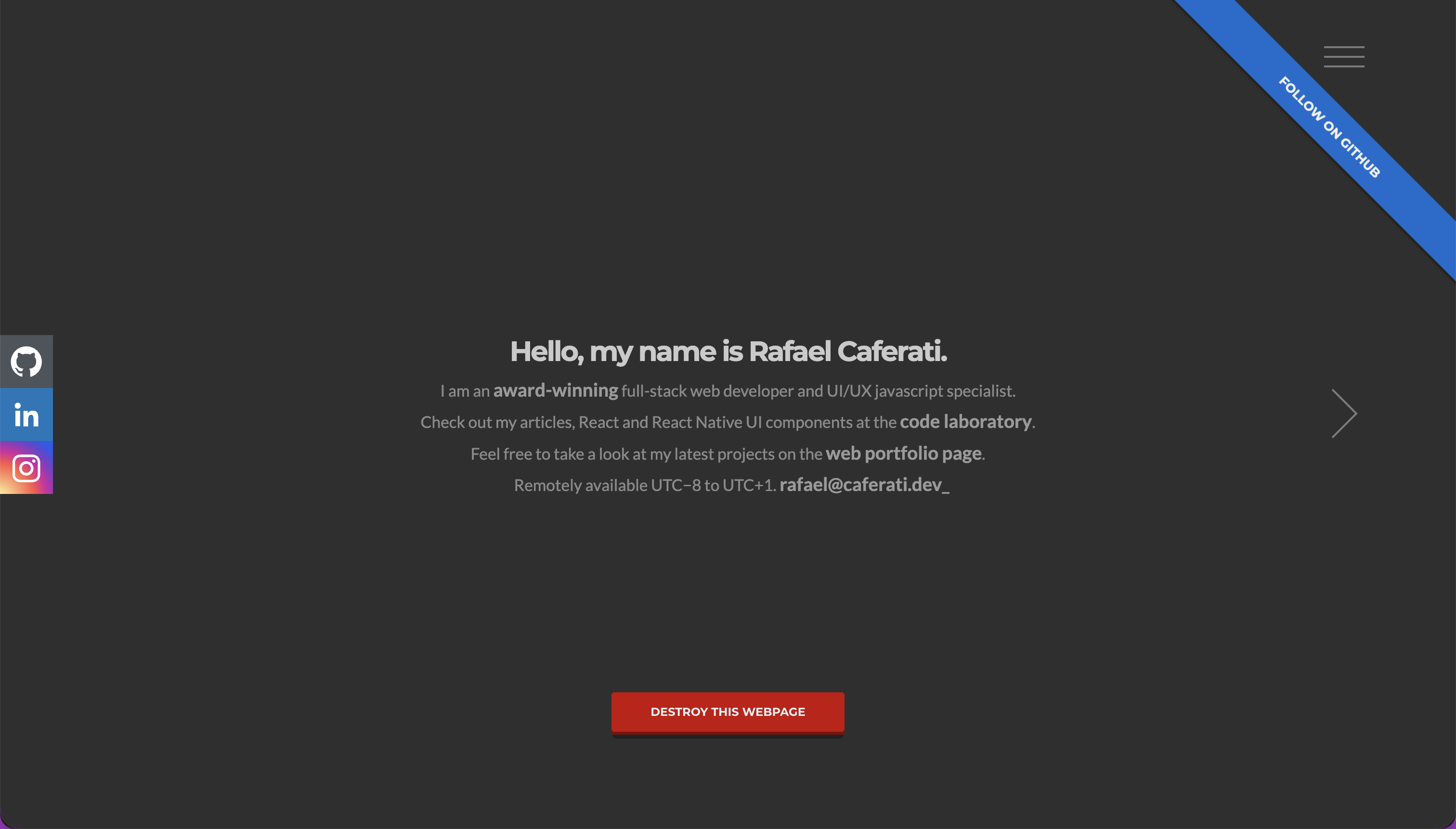

Abstract
The fourteenth terra-solar cycle of the present century feels less like a year and more like a preserved layer of web history. Within that world, the first document still belonged to the server, the continuous surface belonged to the browser, and no settled stack existed to reconcile the split between them.
Templates needed to survive a dual reality. Routes needed to behave as documents for bots and as application states for humans. Web Components carried the romance of a native component future, before life’s update function revealed the long detour reserved for its collapse into that which now it is. Assets passed through build tools that only half agreed about what the web was and had little idea what it was becoming. Animations were negotiated with repaint, compositing, cache, timing, and the unfinished settlement of the Second Browser War.
Preservation was not a platform feature; it was an optimistic act of engineering against time.
That old portfolio was born inside this beautifully ambiguous, unresolved world.
There was optimism in all that uncertainty; few paths felt inevitable, and nothing felt immutable. The web still looked like a greenfield of possible futures, and one could imagine almost anything before the cost of making it real had fully introduced itself. The cost, of course, was time: absurd amounts of it, spent turning engineering ideas into behavior the browser could be forced to obey.
This is a report from that era — a report from BAE — written while interrogating the sediments of a decade-old repository that has outlived the stack assumptions buried in its initial commit.
Before The Modern Stack
The strange fact about remembering 2014 is how unresolved everything felt. The web stack had not yet hardened into a settled decision tree; it was still an open field of probabilities.
React existed, but it had not yet become the air front-end teams breathed. Angular had momentum. Meteor felt like a possible full-stack future. Backbone still carried enough old-web gravity to matter. Web Components carried the promise that the browser itself might become the component model. Handlebars was plain, direct, legible, and useful when server-rendered HTML and client-side templates had to agree.
There was no obvious winner. No default ritual. No path had settled into common sense.
The industry had not yet collapsed around the choices that would later look inevitable; every decision still carried the shimmer of a competing future.
That old portfolio became a stack of decisions made under uncertainty. Express served the first load. Handlebars rendered the page. MongoDB held its pages and items. Redis-backed sessions kept state. SocketIO handled live communication after the first request. RequireJS organized browser code. SASS and Compass shaped the visual system. Grunt and Gulp, together with Vulcanize, moved assets from one web era into another.
Looking back, it all feels absurd and completely reasonable at the same time.
Absurd because a personal portfolio carried a server, a database, sessions, sockets, shared template compilation, a Twitter-backed game leaderboard, real-time experiments, SEO handling, a service worker, versioned bundles, and eventually a static generator.
Reasonable because no single framework could carry the whole weight. Each tool solved one part of the intended experience; the missing framework was the connective structure that made them behave as one surface. If the site needed to feel alive, you had to craft that structure yourself.
The Machinery
The original portfolio was a dynamic NodeJS application. A visitor arrived through an Express route; the server loaded content from MongoDB, Handlebars produced the first full document, and accessed pages stayed cached in memory until the process restarted. That render gave the page a real shape before the browser application took over.
After that, navigation behaved less like document loading and more like state transition. The router intercepted links, requested page data, selected the matching precompiled template, updated the title and header, ran the transition, and preserved one continuous surface.
In its earliest version, page data moved through SocketIO, caught in the orbit of Meteor's DDP-era promise. Templates were already in the browser; only state traveled. Over a persistent connection, the browser requested a payload, the server returned it, and the front end rebuilt and animated the next screen. The architecture carried the belief of that moment in time: after the first document, the website could remain in conversation with the server.
The manual work was everywhere: shared templates, post-transition scripts, reawakened components, history behavior, and separate treatment for bots and browsers. Demos had routes, the game had state, the contact form had flow. The experience had to be indexed, shared, animated, and playable.
Every layer, every struggle, every seam in the machine announced itself to the human building it.
When a transition worked, time with the page had made the sequence physical: route, payload, template, DOM replacement, component wake-up, animation, repaint.
The browser was the final authority: the surface where every element of reality collapsed into executable consequence.
Whatever I believed about a framework, route, component, or timing curve had to become visible there. When it stuttered, it left traces. Debugging meant following those traces back until the wrong state revealed itself.
The Expression of Self
A portfolio can be a blog, an archive, a work-list, a clean index of competence. This one carried a more demanding ambition: before any case study opened, its surface had to become the maximum expression of that which I could build inside a web browser at that moment in time.
Navigation, motion, demos, experiments, articles, components, the contact flow, and the homepage itself became proof surfaces. The portfolio had to express the work by behaving like work; its most memorable gesture was simpler: visitors were invited to destroy the webpage — to destroy the work.
The homepage game made the interface destructible. Cracks, motion, points, and pieces falling out of place made state material. A Twitter-backed leaderboard turned damage into a public trace; visitors left signatures in the ruins through the old web’s favorite social identity layer. Behind it was a work rhythm that felt almost ritual, never romantic: compile, bust cache, trace sockets, refresh, tune collision, repeat.
A normal portfolio asks a visitor to inspect your work; this one asked them to break its surface and leave their mark.
Between 2014 and 2020, the game reached more than 10 million gameplays — a measurement of contact at portfolio scale. Visitors collapsed years of evenings into seconds of damage. They touched it, broke it, restarted it, shared it, and returned to it as an object.
The Web Components side carried the same spirit. Web Components Are Awesome lived on the portfolio’s public surface and won FWA Mobile of the Day. Destroy My Portfolio gave the destructible homepage its own public shape and won CSS Design Awards Website of the Day.
That was the core distinction: the portfolio crossed from presentation into proof. It folded inward, entered its own work-list, and turned its surface into one of the strongest artifacts of the craft it was built to display — a self-reflexive Inception Portfolio.
The Public Signal
The public signal matched the ambition. A site built beyond the normal boundary of a portfolio became a reference point the developer community kept citing, saving, and rediscovering.
Public backlink research recovered 56 unique pages that mentioned or linked to the portfolio, including 23 editorial portfolio guides and listicles. These were not submissions, award entries, or claims I controlled. They were external recognitions: articles, course materials, community lists, examples, and saved references where other people placed the site inside their own understanding of what a developer portfolio could be.
Their titles carried the signal before the paragraphs even opened. The portfolio appeared under frames like 15 Web Developer Portfolios to Inspire You, 10 Awesome Web Developer Portfolios, Developer Portfolios To Check Out, 30 Stunning Web Developer Portfolios for the Ultimate Inspiration, and Must-See Personal Website Examples to Spark Ideas. FreeCodeCamp and Udemy listed it among inspiring developer portfolios. Springboard described it as a “show, don’t tell” example — an interactive demonstration of skill rather than a static claim about it. On GitHub, it surfaced in a community-curated list of “great engineers and their portfolio sites,” placed alongside names such as Lee Robinson, Max Stoiber, Guillermo Rauch, Bruno Simon, David Walsh, Andy Bell, Heydon Pickering, and Maggie Appleton.
Back in 2018, I published How I achieved #1 on google search results for full-stack developer portfolio within the legacy site — a historical claim belonging to its moment. Search Console screenshots, SERP recordings, and backlink analysis made the wake observable. Recorded live queries showed average positions near the top of the first page for full-stack and developer portfolio terms. But the stronger evidence was not only positional; it was social: expressive work produced links, links produced visibility, and visibility curled back into more references.
That old portfolio became a small ouroboros of community attention: discovery feeding references, references feeding discovery.
A decade-long recurrence gave the loop its weight. From 2015 to 2025, the same portfolio kept resurfacing in inspiration articles, developer guides, community lists, and saved references. By the end of that arc, it was no longer just a launch moment; it had become residue — a trace the developer community kept carrying forward.
The pragmatic lesson was blunt: performance, metadata, structured data, static output, HTTPS, and page-title experiments mattered. But the real search force was simpler and harder to engineer: the community kept linking to something they felt worth mentioning.
The Open Sourced Components
Some of the portfolio’s most durable pieces left the page. Its destructible homepage, animated transitions, tactile buttons, and full-surface patterns collapsed into open-source components for the community to install, fork, adapt, and carry into their own products.
React Awesome Slider carried the same obsession with 60 FPS movement, timing, and surface continuity. React Awesome Button preserved buttons as physical interface objects through pressure, progress, themes, social behavior, and animated state. React Native Awesome Button translated that interaction grammar across a different runtime.
Open source allowed the portfolio surface to escape its original frame.
A clean line runs from the old homepage to those libraries. The same physicality remains: motion, state as visible behavior, interaction as material.
That is why BAE legacy work deserves our deepest respect. Its constraints were real, its machinery was excessive, and its craft memory remained productive.
The struggle from that era became part of the material underneath the one now upon us. It lives in public code, archived experiments, articles, demos, package APIs, browser behavior, framework assumptions, and interface patterns: a shared sediment now helping humans and models reason through this new age of software engineering.
The Static Turn
The static generator came around 2018 as a negotiation with age.
By then, static output was no longer merely an old-web compromise. Jamstack had given prebuilt markup, APIs, and CDN delivery a modern name. Gatsby had made React-based static generation feel contemporary. NextJS was bringing static export into a mainstream framework. The wider web was beginning to describe as architecture what this portfolio had arrived at through necessity: generate durable states, serve them close to the user, and keep the runtime only where life still had to happen.
The dynamic stack had done its job, powering the app, socket navigation, game, contact flow, MongoDB-backed content, and experiments that made the site feel alive. Public content had outgrown its dependence on a live database and runtime rendering.
The hand-made generator crawled the localhost app, queried MongoDB, requested full HTML and matching /json payloads, followed demo URLs, and wrote static files. A live application collapsed into stable states: HTML for the document, JSON for the motion. The browser could still animate between pages while the content outlived the system that produced it.
Today, static generation is a normal rendering mode; back then, within its codebase, it was a practical escape hatch. It preserved the experience without pretending the old ways still needed to stay awake.
The static turn was a small act of letting go: trust the generated states, keep the personality, and let the experience outlive its runtime.
The project had grown old enough to learn restraint. Today, legacy.caferati.dev is its visible afterimage: a static site carrying the ghost of the live app without keeping its extensive original machinery alive.
That Which Remains
All that accidental complexity was materially real: build tools that only half agreed about the web, animation timing chained through manual assumptions, every expressive decision carrying a small infrastructure invoice paid with time.
What remains is the physicality of that work. Building an interface forced close contact with the material. Time with the page was the toll: every transition had weight, every browser quirk had texture.
The old rituals left craft memory behind; you deeply understood the page because you had negotiated with it long enough for the work to leave its trace in you.
The portfolio was expensive because almost nothing was collapsed for you. Every possibility had to be forced by hand into its working state; the work accumulated as timing decisions, bug traces, interaction memory, public signals, reusable components, and proof that a personal interface could become part of the work it presented.
That memory still matters. It shaped a shared pragmatism around software surfaces: close to the product, close to the interactions, close to its consequences.
And, for a while, proximity was the binding spell that held the craft together.
Now, AE is upon us, and our practice stands before a broader surface. The invitation is to release the machinery, let go of the lines, and preserve what they taught us by carrying that memory into consequence ownership — into a new age of software engineering — an age defined by what our frameworks of thought make true.